 CodeLynq
The AI development platform your engineering organisation can govern.
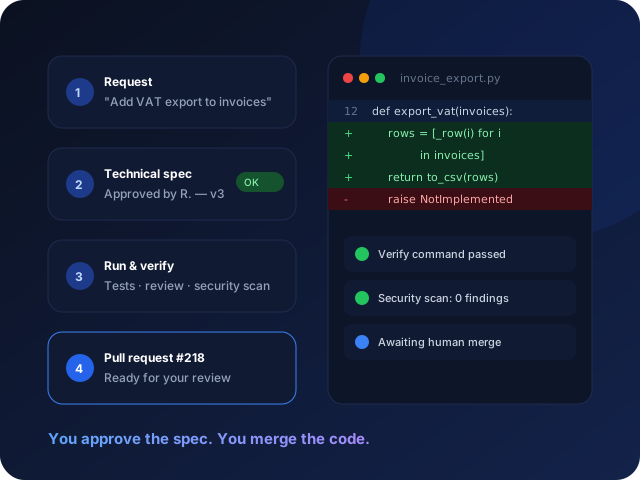
Give CodeLynq a few lines (a meeting note, a written request, a production alert) and it specifies the work against your codebase, builds it, verifies it, reviews and security-scans its own diff, then opens a pull request. You approve the spec. You merge the code. Every step is logged.
Visit codelynq.com Request a demo
CodeLynq never merges and never pushes to a protected branch.
One pipeline from conversation to code
Everything between the idea and the merge
Most tools stop at the task list. CodeLynq carries the work all the way to a pull request, and stays involved after it.
Work arrives however you work
Meeting notes, a two-line request, a production alert, a groomed backlog item or another AI tool over MCP: it all lands in the same reviewed pipeline.
Specs grounded in your codebase
A validation chat surfaces edge cases first. Technical solution documents are then drafted against your actual repository, so engineers review the plan, not a surprise diff.
Runs that check their own work
Before a pull request opens, the run executes your verify command, reviews its own diff, scans it for security issues and updates the docs.
It keeps going after the PR
Failing CI or a changes-requested review sends the run back to the same branch until it is green or hits the limit you set.
Learns your codebase as it goes
Every run and every review adds durable facts about your conventions, layout and pitfalls, so later runs start informed rather than from scratch.
Your code can stay on your machines
A self-hosted runner clones repositories locally so they never reach our servers. Bring your own model key and the spend and retention terms are yours too.
Where the human stays in charge
Three checkpoints that can never be skipped
The scope is validated
Every task is questioned in chat before anything is specified. Unknowns surface while they are still cheap to fix.
You approve the spec
The technical spec needs your explicit approval before a line is written. The architecture stays your call.
You merge the code
The result arrives as a pull request in your normal review flow. If you merge nothing, nothing ships.
Security and governance
Answers for the people who have to sign this off
An AI agent with write access to your repositories is a procurement conversation, not a plugin install. CodeLynq is built to pass that conversation.
- Single sign-on with SAML 2.0 or OIDC against your own identity provider
- SCIM 2.0 provisioning, enforced MFA and IP allowlists
- An audit log you can filter, export or stream to your own endpoint
- Configurable retention for audit entries and run logs
- Secrets encrypted at rest; runs only receive the credentials they need
- Choice of coding agent, set per organisation
Connected to your delivery tools
Pull requests land where your team already reviews code, and results reach the channels your team already watches.
- GitHub
- GitLab
- Bitbucket
- GitHub Actions
- Slack
- Fireflies
- Plaud
- MCP
- Webhooks
Questions engineering leads ask us
No. Every development run ends in a pull request in your connected repository. Your team reviews and merges through its normal workflow.
Not if you do not want it to. A self-hosted runner executes runs on your own machines, while specs, approvals and the audit trail stay in CodeLynq.
Yes. We help you connect repositories, write down your conventions, run a guided pilot on real backlog tasks, train your engineers and scale from there.
Every plan comes with a 14-day money-back guarantee. Prefer to see it first? Send us one task from your backlog and we run it against your repository.
Try it on something from your own backlog
Connect a repository and give CodeLynq one real request. You get back a specified, verified, security-scanned pull request to review.